 Editorial Team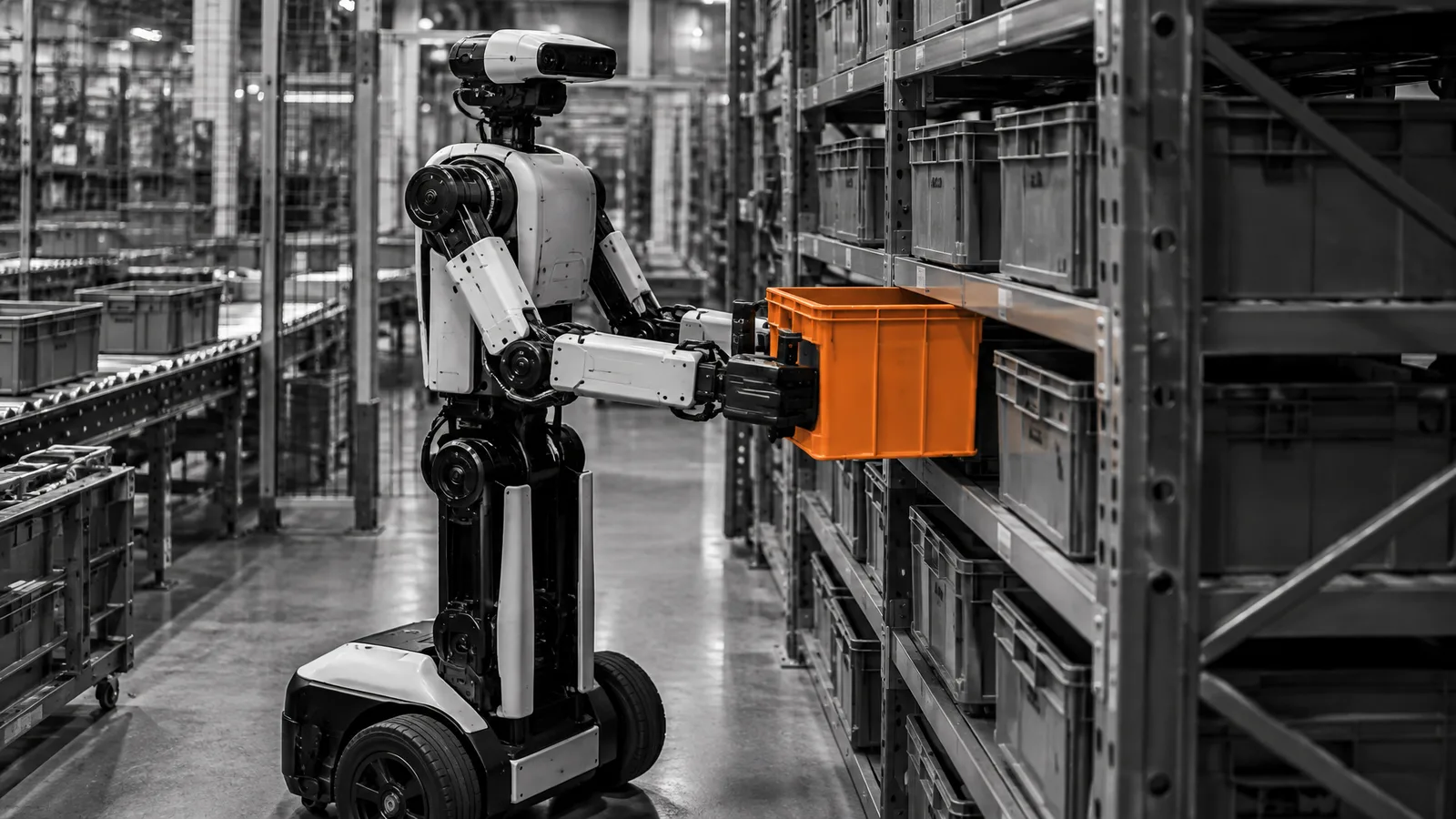
The distance between a humanoid robot demonstration and a humanoid robot in production is measured in uptime, and until this year almost nobody published the number. Three European deployments changed that. Each entry links to its source.
Siemens, electronics factory, Erlangen (Germany)
Robot: HMND 01 Alpha, a wheeled humanoid from the British company Humanoid. Task: removing totes from stacked storage, transporting them across the facility and placing them on a conveyor at a handover point for human workers.
What was measured, per Siemens' announcement:
- 60 tote moves per hour
- Uptime exceeding 8 hours
- Autonomous pick-and-place success above 90%
The trial ran in a live production environment alongside human operators, integrated into Siemens' production systems through the Xcelerator portfolio, with NVIDIA Jetson Thor for edge compute and Isaac Sim and Isaac Lab for simulation and reinforcement learning. Siemens and Humanoid formalised the partnership afterwards.
"Our mission is to create humanoid robots that perform not only in controlled lab settings, but also in real-world factory environments." — Artem Sokolov, CEO and founder, Humanoid
BMW Group, Plant Leipzig (Germany)
Robot: AEON, from Hexagon's robotics division. Task: high-voltage battery assembly and component production, in operations where repetition, precision and ergonomics are the constraint.
Published specifications: 1.65 m tall, 60 kg, up to 2.5 m/s, rated for 15 kg short-term and 8 kg continuous loads. BMW announced the deployment as the first of its kind in a European automotive production environment, with two units running two use cases and both expected in production by year-end.
BMW Group, Spartanburg (United States)
The precedent for Leipzig. BMW has described the earlier US deployment as a success, which is why the programme crossed the Atlantic.
What the numbers do and do not say
Sixty moves an hour is a real throughput figure, and a 90% success rate means one pick in ten needs recovery, which is a workable number for a tote handover and an unworkable one for a torque-critical assembly step. That gap explains the choice of tasks: both European deployments started in logistics and low-risk assembly, not on the line where a failure stops the plant.
Know of another humanoid running in production? Send the public announcement to tips@industrialai.news and we will add it.
Get the next one in your inbox
Every appointment, deployment and move in industrial AI. One email a week, free.